Monday, June 1, 2020

Trident II and DF-31: Comparing the data


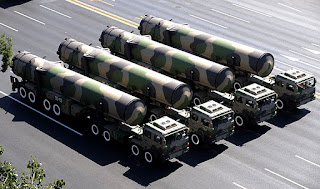
In the previous post about Chinese missiles and the DF-31, technical solutions utilized on Chinese missile engineering, were described.
To set it into relation, a comparison with the benchmark of solid fuel ballistic missiles is helpful.

Trident II


In many ways the UGM-133 Trident II may be regarded as the best ballistic missile ever built and it is more than three decades old.

While U.S military industrial complex produced quite a number of inefficient or ineffective systems in the tactical field, strategic systems are much less affected by this. The missile segment of the U.S Navy's fleet ballistic missile program and its final product, the Trident II, is a ideal example.

The Soviet SLBM program needed to catch up in this area and roughly did so by the 70's. Their liquid fuel SLBM design school was cost-effective, compact, had high throw weight and normally did what the U.S FBM SLBM did, but with one stage less. The price Soviets had to pay were accidents, that come with having a liquid fueled missile inside a submarine, but with increasing experience it was mastered.

The U.S approach simply applied the highest performing solutions, with costs playing a lesser role, resulting in the Trident II.

How to compare?

Comparing secretive strategic weapons systems requires data and numbers, otherwise it is pure speculation.
The situation is quire difficult for the DF-31 series, but OSINT material, easily available via Google search, is more helpful for Trident II.

Physical dimensions are the main requirements to analyse the system. There are two drawings that are claimed to be (intended?) leaks: One detailed technical drawing on the Trident II and one less detailed one from an U.S intelligence briefing about the baseline DF-31.

For a rough performance assessment the following four basic parameters are needed, additional to the dimensions:
  • Isp of fuel/motor/nozzle combination
  • Density of the fuel
  • Percentage of aerodynamic losses of the missile (features, layouts and dimensional ratios)
  • Either propellant mass fraction, or structural ratio, also called deadweight ratio, for the applied technology
Reasonable estimates are necessary for this four parameters.

This data can then be applied to a basic rocket equation, where ϵ is the structural ratio of empty mass divided by fueled mass, and  the payload ratio of upper stages/payload divided by total mass.

The resulting burnout delta-v is then reduced by the estimated aerodynamic losses and compared to delta-v range estimates.

This method allows to create a model about the concerned system, that provides the key data everyone is interested in: Whats the range and at which throw weight.


Quantifying the Trident II benchmark

Technical solutions applied in the Trident II, still represent state of the art in many ways, these include:
  • Carbon fiber filament casing
  • Carbon-carbon composite, single nozzles
  • High Isp fuel with increased density
  • Dense system design which reduces additional weight due to large interstages/shrouds
  • Flexseal flexible nozzle TVC system
  • Avoidance of thrust termination systems or retro-rockets
  • Aerospike to reduce impact of blunt and low length/diameter ratio aerodynamic design
Claims about range and throw weight are published for the Trident II as well as helping data points such as total weight.
Via the calculated model we can get a deeper understanding on what the key capability values and the performance of technical solutions are.

The major uncertainties with the Trident II comes first via its post boost vehicle (PBV), which weight is difficult to estimate. Second to that is the uncertainty about the effective Isp values of each of the three stages.

Results of estimated Trident II

The structural ratio for the applied technology is estimated at ~0,075 and can also be expressed as propellant mass fraction of 0,925. In comparison, accurate estimates for the well known late 1960's technology Minuteman III show a structural ratio of around 0,10.

Aerodynamic losses of total delta-v are estimated at 8% of the total delta V, where the slender, pointer and slower accelerating Minuteman III with its higher l/d ratio is estimated at around 6%

Isp of fuel and motor/nozzle combination is estimated conservatively at 263s sea level and 283 for the vacuum operating stages. Values of near 300s are rumored, but the applied values are still very high. This is due to the NEPE-like fuel utilized, whereas more conventional solid fuels have values of around 250s.

The large "footprint" PBV with the attached guidance section, and penetration aids is estimated at 1200kg. The total payload of the three stages excluding the PBV is set at 2800kg as reported in some sources.

Total weight is known to be 58,9t.

With these constrains the calculation model provides following results:

  • 8000km range at 1600kg throw weight. This is well sufficient for the 14 x ~100kg Mk-4 re-entry vehicles full load, allowing for more or more sophisticated penetration aids.
    It is also in line with the claimed 8 Mk-5 RVs which are heavier and of higher yield.

  • 13000km range at 800kg throw weight. This very long range ICBM configuration would have exactly half the throw weight, translating to 8 Mk-4 or 4 Mk-5.


Quantifying the DF-31 and DF-31A 


In the previous post, the technical details of the DF-31 and DF-31A are described as far as possible with OSINT. There are no accurate drawings with dimensions, nor weights or throw weights available.
Compared to the Trident II benchmark, the differences are following:

  • Conventional aluminium based solid fuels
  • Less efficient 4-nozzle motor design for the DF-31 and DF-31A first stage
  • Less efficient TVC methods
  • High strength steel alloy casings (excluding the possibility of titanium alloy)
  • Lower aerodynamic losses for pointy DF-31 and higher for DF-31A
  • No need for a PBV as single warhead ICBM

Result of estimated baseline DF-31

The following dimensions and weights are assumed for the DF-31:

  • Total weight is estimated at ~40t
  • Diameter of stage I and II is estimated at 2,1mm
  • Diameter of stage III is estimated at 1,32m
  • Total length at 15,5m

Structural ratio of the three relative low l/d ratio stages is estimated at a combined mean value of ~0,13.
Aerodynamic losses estimated at 6-7%.

Isp is set at the reported, similar design, Minuteman value of 237s for the first stage and 255s for the upper stages.

With these constrains the calculation model provides the following result:

7300km range at 500kg throw weight representing a single high yield RV.
This is, with some uncertainty, validated by the supposedly leaked U.S intelligence report.


Results estimated for DF-31A

Dimensional changes of the DF-31A to the DF-31 include: 

  • Shorter length of estimated 14,5m
  • Stage III diameter increased to 1,6mm
  • Weight increased to ~41t

Structural ratio of steel casing motor improved to 0,11-0,12, approaching Minutman III levels which uses titanium alloy in stage II and fiberglass composite in stage III. New TVC methods for upper stages of the DF-31A are also a contributor to this, as well as potential metallurgical improvements. 

Aerodynamic losses are estimated at 7-8%

Isp remains at 237s for stage I and significantly improves to 270s for the upper stages.

With these constrains the calculation model provides the following result:

10300km range at 500kg throw weight representing a single high yield RV.


Impact

The estimated and calculated values with their results, illustrate the impact of the different system parameters on ballistic missile performance.

At ~40t, the DF-31 is significantly lighter than the ~60t Trident. However better technology gives the Trident II a vastly superior system performance.

Of course the DF-31 may suit Chinas needs better in terms of costs and the employed counter-value nuclear warfare doctrine instead of counter-force.

It can also be used to interpret the need China felt to develop the DF-31AG, to attain 13000km-14000km range class performance and better penetration aids. DF-31AG may use a composite first stage or upper stages derived from the DF-41 development, the information is insufficient to do credible modelling.

The single largest contributer is shown to be the motor design: Its carbon composite, with flexible single nozzle TVC for the Trident II.
These features make the difference and the Trident II so high performing.

Thursday, May 28, 2020

The DF-31: Chinas technological path to a survivable ICBM


As China's ambitions grew to superpower level, the quest for a survivable, compact, launch-on-demand ICBM became inevitable.

In the 60's, the U.S Polaris SLBM was the system that accomplished all three above requirements.
Its MRBM-class range was no hurdle, the basic technology fundament on which it was built clearly offered growth potential up to ICBM-class range.

Back then in the 60's, just like France, China set itself the goal to reach the technology level to build a equivalent to the Polaris.

In the 60's China had just began mastering Soviet second generation liquid-fuel technology level ballistic missiles and was still very far away to achieving something like the Polaris.
Chinese intelligence/engineers saw the Polaris quickly evolving from the -A1 to the -A-3 and then to the IRBM-range class Poseidon.

This attractive technology path was strengthen to be the best approach as Chinese witnessed France going the same path with their M1, M2 and M20 SLBM. 

Two key technologies had to be mastered:

  • A high strength steel allow, well weldable, in order to reduce casing weight and achieve the required structural-ratio/mass fraction.

  • A thrust vector control system to avoid fins and hence safe on weight and allow container/silo launch, fulfilling future SLBM requirement.

Other technological hurdles were the required cold launch, the thrust termination and the staging of the second stage from the first stage that still created thrust after nominal burnout. 
Most other technological issues, such as guidance, had been already mastered by the liquid fuel program. 

The star of Chinese missile engineering

The product of this super-project was the JL-1 SLBM of the 1980's and its later DF-21 mobile TEL based MRBM variant.

Like the French, Chinese opted for a conservative approach on the key issue of TVC: four, relative easy to manufacture, relative small length nozzles for compactness.

Three TVC options were available:

  1. Hinged, movable nozzles which were complex and hard to master, famously applied in the Minutman up until today.
  2. Rotating nozzles which had lower technology risks and were first applied in the Polaris A-3
  3. Jetavators which was the lowest risk approach but relatively heavy and created thrust losses

A forth one, jet vanes were well known to the Chinese and DF-11 and DF-15 programs of same development generation applied them, in their solid fuel optimized variation.
However the main problem with Jet vanes beside increased length, was twofold; they created thrust losses of 2-5% like Jetavators, but they also had the requirement of a low corrosive solid fuel.
The combined losses would reduce the Isp of the stages so much, that the two future goals of compactness and IRBM-ICBM-range would hardly be achievable.

Up until today we don't know whether hinged or rotating nozzles were used in the JL-1/DF-21 but rotating nozzles are the most likely candidate. The French are also believed to have used this TVC method until they mastered the single nozzle TVC of the 80's vintage M4.

At this point it should be noted that beside the compact Soviet liquid fuel SLBM school and the superior U.S FBM program, only China and France were participating in this technological race.

In the field of casings, Chinese metallurgy had reached a level that could support the program by the 1980's.
At that point U.S SLBMs already used fiberglass and even Kevlar for their composite casings


The baseline DF-31

The range/throw-weight performance of the JL-1/DF-21 was not high; at below 2000km it could be compared to the 1960 vintage Polaris A-1, representing a gap of 25 years.
Looking at the few players still in this game, it was nonetheless a great achievement for the Chinese engineers and created a motivation to reach beyond the DF-21.

The DF-31 replaced the digit 2 with a 3 as it was the evolved form of a technology, that had been mastered in the DF-21 at all its bottlenecks.

Hence the development strategy was simple:

  • Increased diameter steel casing to a size, that would allow intercontinental range performance
  • Add a modified DF-21 stage as third stage on the two new, increased diameter, first and second stages
  • Use the mature rotating four-nozzle TVC system on all three stages

The program went according to the plan: Instead of the more than 15 years development time of the JL-1/DF-21, the DF-31 development was finished in the 90's.

However the range/throw-weight performance was, as already anticipated, low and the two main contributors, beside nuclear warhead miniaturization technology level, were clear:
  • High steel casing weight
  • Lowered Isp due to the four nozzle design, compared to a efficient large single-nozzle.

While a small portion of CONUS could be target by the mobile, nuclear tipped DF-31, it was clear that the next version would have to introduce new technologies in order to improve the range.


Technology enabled: The DF-31A

Like the improvement program of the Minutman I to II and III, the first stage remained unchanged in the next generation DF-31A.

Casing materials were improved but also remained steel for all three stages.

The development strategy was to improve what had the greatest impact on range/throw-weight; concentration on new second and third stages.
A departure from the four-nozzle rotating TVC design was necessary to improve stage Isp/efficiency by using single large nozzles.
TVC technology that would have enabled this and known from U.S examples, were either nozzle liquid-injection or a "flexseal" flexible nozzle.

Mastering one of the two would have created following issues:

  • Nozzle liquid-injection was risk-wise achievable, but normally increased complexity/maintenance and involved toxic liquids, that combined, would have decreased the robustness of the land-mobile system and its future SLBM variant.
  • A flexible nozzle would have high risks involved at Chinas 2000s technology level
The solution for the third stage is known and represents a unique and novel approach in terms of missile technology worldwide:


The nozzle design was a large fixed one allowing high Isp, close to what the solid fuel is able to optimally deliver.
TVC is achieved without involving hot parts by changing the center of gravity of the stage. The mass of the relative large re-entry vehicle is moved by a hydraulic system, which in turn creates a change of the effective thrust vector.

This elegant "cold" TVC approach required intensive roll maneuvers, which in turn required a relative large/heavy thruster system. This adds some complexity and potentially maintenance requirements, if it is liquid fuel based.
The TVC system represents the first main missile technology innovation of the Chinese, who up to that point relied on foreign, proven solutions.


The second stage achieves its required Isp improvement by a large fixed nozzle which like the thrid stage nozzle is made of lightweight carbon-carbon, or one step lower technology, carbon-phenolic composite. This improves structural ratio even though steel remains the casing material.

TVC of the second stage remains an open question.
During the U.S Polaris programs it was theorized based on experience that the second stage, after having passed max q and with very thin atmosphere remaining at stage-1/stage-II separation altitude, could omit a TVC system.
Did Chinese experience with flight data from the JL-1/DF-21 program indicate something similar?
Maybe in combination with the following approach:
After stage-I burnout, the shroud of the DF-31A would eject itself from stage-III, via its top small rockets.
The same TVC principle of stage-III would then be utilized for limited TVC action on stage-II, by hydraulically moving the relative large RV mass.

Another technology innovation in the DF-31A was the removal of the third stage thrust termination system of the DF-31.
This additional weight saving is achieved by continuously re-calculating the resulting trajectory and do necessary corrections by the stage-III TVC system. This technology, called GEMS by the U.S, was first employed in the Trident-I and requires computing power and more sophisticated guidance algorithms.
Result was that the DF-31A stage-III could completely burn out the last remaining fuel and still maintain the right trajectory for low CEP RV impact.

All these improvements allowed a range/throw-weight improvement that allowed targeting the U.S westcoast.
The new system also became smaller, allowing the development of its JL-2 SLBM variant which has to pay a range/throw-weight penalty for being a SLBM due to necessary re-designs.


Up to Minutman III range: DF-31AG

As a kind of benchmark for ICBM range/throw-weight performance, the Minteman III's 13000km range would allow to put all of the U.S, into the range of Chinese land-mobile ICBMs. Not only from the peripheral regions but from deep inside central China where protection against the opponent is highest.

Since no photo of the DF-31AG airframe exists in the internet, very few information about it is available. It is somewhat longer than the DF-31A.

A largest contribution to a higher performing system would be to put aside the U.S role model of the Minutman III, which up until today retains the early 1960's vintage, four nozzle, steel casing first stage.

However a more logical conclusion could be the utilization of potentially scaled or not, DF-41 technology in the upper stages.
Even less is known about the DF-41 but if the overall diameter is not uniform, its possible that a 2m diameter upper stage of the DF-41 is used as second, or third stage in the DF-31AG.


At Chinese 2010's technology level the technological improvements could be based on the following three:
  • Filament casing at least for upper stages made of Aramid/Kevlar or carbon fiber.
  • Single flexible nozzle for TVC
  • More energetic solid fuel
It would be striking to expect a steel casing used for upper stages like the DF-31A in a Chinese strategic-only system developed in the 2010's.

A MIRV bus on the DF-31AG is a possibility if the third stage diameter was increased to make the missile uniform. However, if as expected, the obsolete first stage is retained, the larger diameter third or lighter composite second stage would only translate into a improved range/throw-weight performance.

It is expected that Chinese re-entry vehicle size and weight is still behind Soviet/Russian and U.S level as indicated by the 2000's vintage RV of the DF-31A.
Therefore a counter-value single warhead role for the DF-31AG appears most likely.